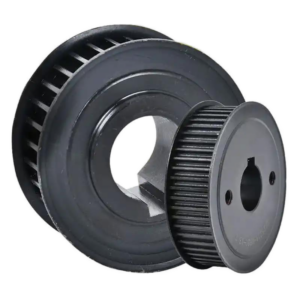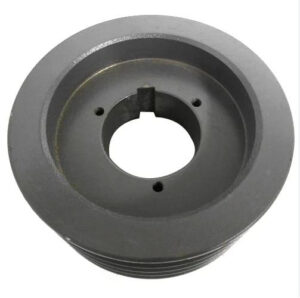
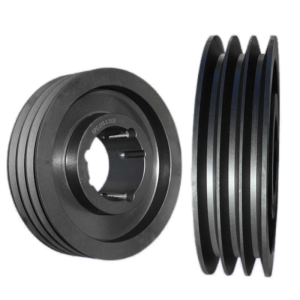
In power transmission systems, pulleys play a fundamental and irreplaceable role. As a key mechanical component used together with belts, pulleys are responsible for transmitting power, adjusting speed, and ensuring stable operation between driving and driven machinery.
First, pulleys serve as the primary medium for power transfer. By working with V-belts, timing belts, or flat belts, pulleys transmit rotational energy from motors, engines, or gearboxes to other mechanical components. This allows power to be delivered smoothly over a certain distance without the need for direct shaft connections, increasing flexibility in equipment design.
Second, pulleys are essential for speed and torque regulation. By changing the diameter ratio between the driving pulley and the driven pulley, the rotational speed and torque of the system can be easily adjusted. This makes pulley systems widely used in applications where different operating speeds are required, such as conveyors, fans, pumps, compressors, and agricultural or industrial machinery.
In addition, pulleys help improve system stability and protect equipment. Belt-driven pulley systems can absorb shock and vibration during operation, reducing noise and minimizing impact loads on bearings and shafts. In overload situations, belts may slip instead of causing severe mechanical damage, providing a natural safety mechanism for the transmission system.
From a maintenance perspective, pulleys also offer clear advantages. Compared with gear or chain drives, pulley systems are simpler in structure, easier to install, and more cost-effective to maintain. Properly designed and manufactured pulleys can significantly extend belt life and improve overall transmission efficiency.
In conclusion, pulleys occupy a vital position in power transmission equipment. Their ability to transmit power efficiently, regulate speed, reduce vibration, and protect machinery makes them an indispensable component in modern mechanical and industrial systems. Choosing high-quality pulleys and matching them correctly with belts is essential for achieving reliable, efficient, and long-term operation of transmission equipment.