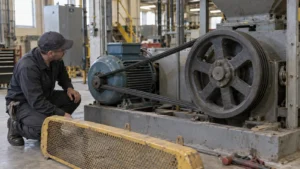
Experiencing abnormal V-belt pulley wear? Learn the 5 most common causes, how to inspect your drive system, and proven solutions to extend pulley and belt service life.
Introduction
When a newly installed V-belt begins to wear out after only a few months, many maintenance teams immediately suspect the belt itself. However, in most industrial applications, premature belt failure is often a symptom of deeper issues within the pulley drive system.
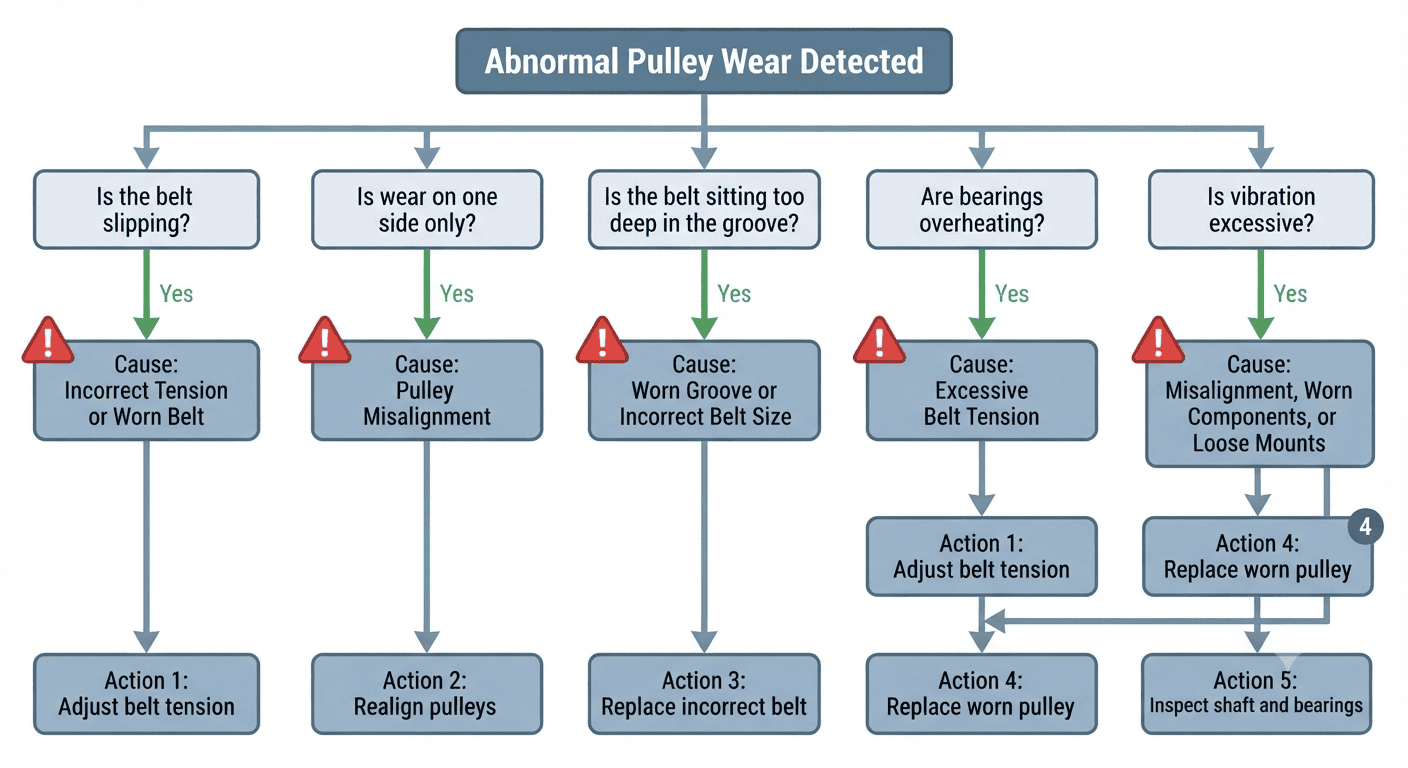
Improper tension, pulley misalignment, incorrect belt selection, worn grooves, and shaft system defects can all accelerate pulley and belt wear, reduce transmission efficiency, increase energy consumption, and eventually lead to unexpected downtime.
Based on common field observations in industrial power transmission systems, this article explains the five most common causes of abnormal V-belt pulley wear, how to identify them, and what corrective actions should be taken.
1. Incorrect Belt Tension
Common Symptoms
- Belt slipping during startup
- Squealing or chirping noises
- Excessive belt dust
- Premature belt cracking
- Bearing overheating
Both under-tensioning and over-tensioning can damage a drive system.
Why It Happens
A V-belt transmits power through friction between the belt sidewalls and the pulley grooves. When tension is too low, insufficient friction causes slipping. The resulting heat hardens the rubber compound and accelerates wear. When tension is too high, excessive radial loads are transferred to bearings and shafts, increasing operating temperatures and reducing component life.
Inspection Procedure
- Shut down and lock out the equipment.
- Inspect the belt surface for glazing or burn marks.
- Measure belt tension using a tension gauge.
- Compare measurements with the belt manufacturer recommendations.
Recommended Solution
- Adjust motor position or tensioning device.
- Use a belt tension gauge instead of estimating by hand.
- Ensure equal tension across multiple belts.
- Recheck tension after initial run-in periods.
2. Pulley Misalignment
Common Symptoms
- One-sided belt wear
- Belt wandering within the groove
- Excessive edge wear
- Increased vibration
Why It Happens
Misalignment occurs when the driver and driven pulleys are not positioned in the same plane or when shafts are not parallel. As the belt enters and exits the pulley grooves, side forces develop and continuously rub against the groove walls. This creates uneven wear patterns and shortens both belt and pulley life.
Inspection Procedure
- Place a straightedge across pulley faces.
- Check for gaps between the straightedge and pulley surfaces.
- Measure angular and parallel alignment.
- Verify shaft parallelism.
Laser alignment tools provide the highest accuracy for critical applications.
Recommended Solution
- Realign motor and driven equipment.
- Verify alignment after maintenance activities.
- Reinspect alignment whenever belts are replaced.
Field Example
A packaging machine experienced severe belt edge wear every three months. Investigation revealed that the motor had been repositioned during maintenance without realignment. After laser alignment was performed, belt service life increased to over 18 months.
3. Incorrect Belt and Pulley Matching
Common Symptoms
- Belt sitting too deep in the groove
- Belt riding excessively high
- Reduced power transmission efficiency
- Unusual wear patterns
Why It Happens
Each pulley groove is designed for a specific belt profile such as SPA, SPB, SPC, 3V, 5V, or 8V. Using the wrong belt section changes the contact geometry: undersized belts may bottom out in the groove, while oversized belts may contact only the groove edges. In either case, power transmission efficiency decreases and wear accelerates.
Inspection Procedure
- Verify belt profile markings.
- Compare belt specifications with pulley groove dimensions.
- Check whether the belt contacts the groove sidewalls properly.
Recommended Solution
- Match belt and pulley standards correctly.
- Replace incompatible belts immediately.
- Use matched belt sets in multi-belt drives.
4. Pulley Groove Wear and Surface Damage
Common Symptoms
- Belt slipping despite correct tension
- Visible groove deformation
- Groove sidewall polishing
- Reduced transmission efficiency
Why It Happens
Over time, constant friction gradually changes groove geometry. As grooves become wider or develop concave wear patterns, sidewall contact decreases and the belt loses gripping capability. The resulting slippage creates additional heat and accelerates deterioration. Dust, corrosion, and abrasive particles can further increase wear rates.
Inspection Procedure
- Visually inspect groove surfaces.
- Look for cracks, corrosion, or uneven wear.
- Measure groove dimensions using wear gauges.
- Compare measurements with manufacturer specifications.
Recommended Solution
- Replace severely worn pulleys.
- Keep pulley grooves clean and free from contaminants.
- Consider ductile iron or hardened pulley materials for demanding environments.
5. Shaft System Design and Installation Problems
Common Symptoms
- Repeated bearing failures
- Excessive vibration
- Shaft journal wear
- Pulley wobbling during operation
Why It Happens
In overhung pulley arrangements, the pulley is mounted outside the bearing support span. This creates significant bending moments on the shaft and increases bearing loads. Over time, shaft deflection, fretting wear, and bearing damage can occur. Poor shaft tolerances or improper bearing fits can worsen the problem.
Inspection Procedure
- Check shaft runout.
- Inspect bearing seating surfaces.
- Measure vibration levels.
- Verify bearing fits and tolerances.
Recommended Solution
- Use between-bearing pulley arrangements whenever possible.
- Improve shaft hardness through heat treatment.
- Maintain proper interference fits.
- Install vibration-reduction measures where necessary.
Quick Troubleshooting Guide
| Cause | Key Symptom | Primary Inspection | Solution |
|---|---|---|---|
| Incorrect Tension | Slipping, squealing | Measure with tension gauge | Adjust tensioning device |
| Misalignment | One-sided belt wear | Straightedge check | Realign pulleys |
| Belt-Pulley Mismatch | Belt too deep/high in groove | Verify belt profile | Replace incorrect belt |
| Groove Wear | Slip despite correct tension | Wear gauge measurement | Replace pulley |
| Shaft Issues | Pulley wobbling | Check shaft runout | Improve shaft/bearing fit |
Preventive Maintenance Best Practices
To maximize service life, maintenance personnel should:
- Inspect belt tension monthly.
- Verify pulley alignment during every belt replacement.
- Keep pulley grooves clean and free from oil contamination.
- Monitor vibration and bearing temperatures.
- Record maintenance history for trend analysis.
- Replace worn pulleys before installing new belts.
A proactive maintenance program can significantly reduce unplanned downtime and improve overall drive system reliability.
Frequently Asked Questions
Can a worn pulley damage a new V-belt?
Yes. Installing a new belt on a worn pulley often results in rapid belt wear because the groove geometry no longer provides proper sidewall contact.
How often should pulley alignment be checked?
Alignment should be checked whenever belts are replaced and at least every six months in continuous-duty applications.
Should both pulleys be replaced at the same time?
Not necessarily. Replacement depends on the wear condition of each pulley. Both pulleys should be inspected individually.
Can rust cause pulley wear?
Light surface rust typically has little impact. However, severe corrosion can alter groove geometry and accelerate belt wear.
What is the average service life of a V-belt pulley?
Under proper operating conditions, industrial cast iron pulleys can often provide 5 to 10 years of service before replacement becomes necessary.
Conclusion
Abnormal V-belt pulley wear is rarely caused by a single factor. In most cases, incorrect belt tension, pulley misalignment, belt-profile mismatches, groove wear, or shaft system defects are responsible for premature failures.
By understanding the root causes, implementing proper inspection procedures, and following preventive maintenance practices, engineers and maintenance teams can significantly improve system reliability, reduce operating costs, and extend the service life of both belts and pulleys.
If you need assistance selecting industrial V-belt pulleys, taper bushings, or other power transmission components, the engineering team at NDS Belt Pulley is ready to help.
When wear indicates a pulley is beyond economical repair, NDS also supports belt-pulley replacement and custom supply for standard and OEM specifications.