A multi-ribbed belt pulley and a traditional belt pulley differ in their usage, structural design, and performance. Below is a comparison of their usage methods as well as their advantages and disadvantages:
1. Structural Design & Working Principle
- Multi-ribbed Belt Pulley:
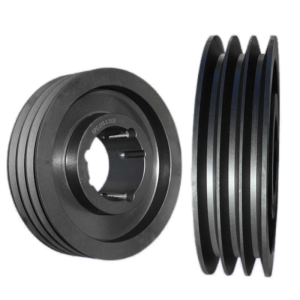
- A multi-ribbed pulley typically uses multiple V-shaped ribs (a variant of V-belts). The pulley has multiple grooves to engage the ribs and transmit power.
- Each rib shares part of the load, reducing the stress on any single rib, which increases efficiency and service life.
- Traditional Belt Pulley:
- Traditional pulleys usually use flat belts or single V-belts. The pulley typically has one or only a few grooves.
- Power is transmitted through a single belt bearing most of the load.
2. Differences in Usage
- Multi-ribbed Belt Pulley:
- Commonly used in high-power equipment requiring high efficiency and long hours of continuous operation.
- Because it uses multiple ribs, the load is distributed, reducing overload risk on a single belt.
- Suitable for high-load environments such as mechanical drives and automotive engine systems.
- Traditional Belt Pulley:
- Widely used but mainly suitable for medium-load transmission systems.
- Requires more frequent maintenance, especially as belts can wear out due to overload or aging.
- Common in household appliances, small machines, and low-load equipment.
3. Advantages & Disadvantages
Multi-ribbed Belt Pulley
Advantages:
- High transmission efficiency: Multiple ribs work together, each carrying less load, resulting in smoother power transmission.
- Load distribution: Multiple ribs share the load, reducing wear on individual belts.
- Space-saving: Multiple narrow ribs allow higher power transmission in a compact space.
- Long service life: Lower wear and higher tensile strength lead to longer lifespan.
Disadvantages:
- Higher cost: The system is more expensive due to multiple ribs and specialized pulleys.
- More complex installation and maintenance: The design is more complex and may require more time and effort to maintain.
- Potential for higher noise: Although quieter than some systems, still may produce more noise than direct-drive solutions.
Traditional Belt Pulley
Advantages:
- Low cost: Traditional belts and pulleys are inexpensive, suitable for budget-sensitive applications.
- Simple and easy to use: Simple structure makes installation and maintenance easier.
- High adaptability: Applicable to a wide range of equipment and environments.
Disadvantages:
- Lower efficiency: A single belt carries high load, resulting in higher risk of slipping and faster wear.
- Limited load capacity: Cannot handle high loads; belts may break under overload.
- Frequent maintenance: Belts wear faster and need regular inspection and replacement.
4. Summary
- A multi-ribbed belt pulley is ideal for high-load, high-efficiency, long-duration applications. Though costlier and more complex, it provides better performance and longer life.
- A traditional belt pulley is more suitable for low-load, cost-sensitive situations. It’s simple and economical but limited in load capacity and efficiency.