1. Introduction
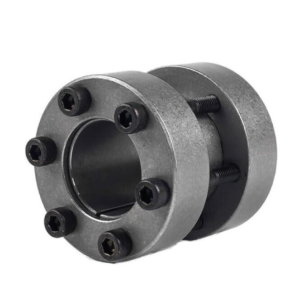
Locking assemblies—also known as shrink discs or expansion sleeves—are mechanical transmission components used for keyless connections between shafts and hubs.
By tightening the clamping bolts, the assembly creates radial expansion and contraction, generating a frictional connection capable of transmitting torque without using keys or splines.
These devices are widely used in gearboxes, pulleys, conveyor rollers, and high-torque transmission systems. Their design and dimensions are standardized in China primarily by GB/T 28701-2012 and the earlier JB/T 7934-1999.
2. Function and Working Principle
A locking assembly consists of inner and outer conical rings and tightening bolts.
When bolts are tightened:
- The outer ring contracts.
- The inner ring expands.
- This radial pressure secures the hub to the shaft through friction.
The connection allows high torque transmission with precise concentricity, and it avoids the stress concentrations typical of keyed joints.
3. Overview of Standards
| Item | GB/T 28701-2012 | JB/T 7934-1999 |
|---|---|---|
| Full Name | Locking Assemblies | Locking Assemblies – Types and Basic Dimensions |
| Standard Type | National Standard (GB/T) | Machinery Industry Standard (JB/T) |
| Issued By | AQSIQ / Standardization Administration of China | Ministry of Machinery Industry |
| Implementation Date | Feb 1, 2013 | Mar 1, 1999 |
| Current Status | Active (valid) | Replaced by GB/T 28701-2012 |
Relationship:
JB/T 7934 was the first Chinese standard defining the types and dimensions of locking assemblies.
GB/T 28701-2012 replaced it with expanded types, higher precision, and international compatibility.
4. Technical Comparison Between the Two Standards
| Comparison Aspect | JB/T 7934-1999 | GB/T 28701-2012 | Impact |
|---|---|---|---|
| Coverage | Focused on types and dimensions only | Includes terms, definitions, structure, dimensions, testing, inspection, marking, packaging, and storage | More comprehensive |
| Model Range | Z1–Z9 | ZJ1–ZJ19 | Expanded model system |
| Shaft Diameter Range | 6 – 500 mm | 6 – 1000 mm | Broader applicability |
| Structural Types | Basic single or double taper | Includes short type, heavy-duty, reverse mounting, flange type | More options |
| Tolerance & Surface Finish | Not clearly specified | Defined fits (shaft h6/h7/h8, hub H7/H8) and roughness Ra ≤ 1.6 µm | Better quality control |
| Material & Heat Treatment | Not specified | Recommended materials and hardness | Improved consistency |
| Testing & Acceptance | None | Includes torque, coaxiality, and installation tests | Higher reliability |
| Marking & Packaging | Minimal | Standardized for transport and export | International compatibility |
✅ Summary
JB/T 7934 = Old industry standard (basic dimensions).
GB/T 28701 = Upgraded national standard (structure + dimensions + testing + internationalization).
5. Differences Among Locking Assembly Models (ZJ1–ZJ19)
| Model | Structure Features | Typical Applications | Notes |
|---|---|---|---|
| ZJ1 | Single taper surface, outer sleeve contracts and inner expands | Standard type for general use (belt pulleys, couplings) | Easiest to install |
| ZJ2 | Double taper, symmetrical design | High concentricity and precision applications | Balanced tightening |
| ZJ3 | With flange for axial positioning | High alignment accuracy | Larger outer diameter |
| ZJ4 | Double taper + flange | High torque capacity | Higher cost and space requirement |
| ZJ5 | Extended length, more bolts | Heavy-duty or large-diameter shafts | Very high torque |
| ZJ6 | Short type (reduced axial length) | Space-limited designs | Lower torque |
| ZJ8 | Slotted outer ring for easy disassembly | Easy maintenance | Slightly lower strength |
| ZJ9 | Compact and lightweight | Small power devices, sensors | Low torque capacity |
| ZJ10 | Thick-wall heavy-duty type | Large gears, fan hubs | Designed for very high torque |
| ZJ11–ZJ19 | Special variants (reverse, twin-row, anti-slip, etc.) | Custom applications | Mainly OEM-specific |
6. Typical Dimensional Examples (Partial Reference)
| Model | Shaft Diameter d (mm) | Outer Diameter D (mm) | Length L (mm) | Engagement Length l (mm) |
|---|---|---|---|---|
| ZJ1 | 100 | 114 | 21 | 18.7 |
| ZJ2 | 20 | 47 | 20 | 27.5 |
| ZJ3 | 50 | 76 | 30 | 35 |
| ZJ5 | 100 | 145 | 60 | 65 |
| ZJ6 | 25 | 55 | 18 | 20 |
| ZJ12A | 25 | 55 | 32 | 40 |
(Exact dimensions depend on the specific product series and manufacturer.)
7. Selection Guidelines
| Application Scenario | Recommended Models | Key Reason |
|---|---|---|
| General shaft–hub connection | ZJ1 / ZJ2 | Simple and cost-effective |
| High torque or shock load | ZJ5 / ZJ10 | Larger contact area and bolt count |
| Limited installation space | ZJ6 | Short axial length |
| Precise alignment required | ZJ3 / ZJ4 | With flange positioning |
| Light load / small mechanism | ZJ9 | Compact, lightweight design |
8. Dimensional and Structural Progress in GB/T 28701
Compared with the old JB/T 7934, the GB/T 28701 standard significantly improves:
- Dimensional accuracy and tolerance definitions.
- Torque transmission rating consistency across manufacturers.
- Surface finish and material recommendations for longer service life.
- Testing methods for torque, runout, and concentricity.
- Global compatibility—its dimensions closely match those of international series such as RINGFEDER RfN 7005 to 7015.
9. Practical Implications for Engineering and Procurement
- For Designers: Use GB/T 28701 as the design and calculation reference.
- For Procurement & International Trade: GB/T 28701’s model system aligns better with European and Japanese products, easing export and replacement.
- For Maintenance of Older Equipment: When encountering JB/T 7934 labels (e.g., “Z1”), use equivalent GB/T 28701 types (e.g., “ZJ1”)—dimensions are mostly compatible.
10. Conclusion
The evolution from JB/T 7934-1999 to GB/T 28701-2012 marks a major step in standardizing China’s locking assembly industry.
The new GB/T standard not only expands model coverage (ZJ1–ZJ19) but also enhances precision, testing, and international interoperability.
In short:
JB/T 7934 = foundation of domestic locking assembly design.
GB/T 28701 = modern, globally aligned, performance-oriented upgrade.
When selecting locking assemblies, engineers and buyers should always specify GB/T 28701-2012 to ensure compatibility, quality, and long-term reliability in both domestic and international machinery systems.