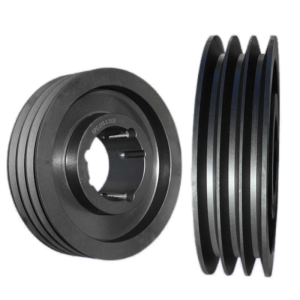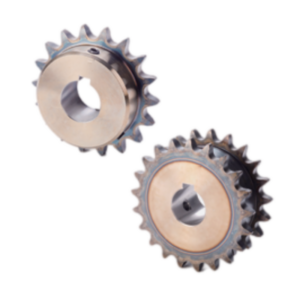
Pulleys and sprockets are fundamental power transmission components, widely used in machinery, automotive systems, and industrial equipment. Their performance, durability, and cost-effectiveness are heavily influenced by the choice of materials and manufacturing processes. This article provides an overview of the common materials and machining techniques employed in their production.
I. Materials for Pulleys and Sprockets
The material selection depends on application requirements such as load, speed, operating environment, precision, and cost.
1. Metals
- Carbon Steels (e.g., AISI 1018, 1045, 4140): The most common choice for industrial applications. Low-carbon steels (1018) offer good machinability for lighter loads. Medium-carbon steels (1045, 4140) provide higher strength, wear resistance, and can be heat-treated (hardening and tempering) for demanding applications. They offer an excellent balance of strength, toughness, and cost.
- Alloy Steels: Used for high-stress, high-wear, or high-impact applications. Alloying elements like chromium, molybdenum, and nickel enhance hardenability, strength, and fatigue resistance.
- Stainless Steels (e.g., 303, 304, 316): Selected for their superior corrosion resistance in food processing, chemical, marine, or washdown environments. Austenitic grades (304, 316) offer the best corrosion resistance but are tougher to machine. Martensitic grades (410) can be hardened.
- Cast Iron (Gray Iron, Ductile Iron): Excellent for large, durable pulleys (especially V-belt pulleys) due to its good castability, damping properties (reduces vibration), and wear resistance. Ductile iron offers added strength and toughness.
- Aluminum Alloys (e.g., 6061, 2024): Ideal for applications where weight reduction is critical (e.g., aerospace, robotics, high-speed drives). They provide good strength-to-weight ratio, corrosion resistance, and machinability, though wear resistance is lower than steel.
- Brass/Bronze: Sometimes used for specific applications like corrosion resistance, non-magnetic properties, or where spark resistance is needed. Bronze bushings are often pressed into bore holes.
2. Non-Metals
- Plastics (Nylon, Polyacetal/POM, UHMW, Reinforced Composites): Used for light-to-medium duty, low-noise, and corrosion-resistant applications. They are lightweight, require no lubrication in some cases, and are cost-effective for high volumes via injection molding. Fiber-reinforced plastics offer increased strength.
- Sintered Metals (Powder Metallurgy): Components are pressed from metal powder and sintered. Suitable for high-volume production of complex, small-to-medium sized sprockets/pulleys with good dimensional control and minimal material waste. Density and strength can be high but are generally lower than wrought materials.
II. Manufacturing and Machining Processes
1. Primary Forming Processes
- Casting: Common for iron pulleys and large, complex shapes. Sand casting is used for low-volume, large parts. Die casting is used for high-volume aluminum or zinc parts. It provides a near-net-shape form, reducing subsequent machining.
- Forging: Produces parts with superior grain structure, strength, and fatigue resistance compared to casting or machining from bar stock. Typically used for high-performance steel sprockets in heavy machinery.
- Stamping/Blankinɡ: Used for manufacturing thin-gauge sheet metal pulleys, especially for automotive accessory drives (fan pulleys, alternator pulleys). It is a high-speed, high-volume process.
- Powder Metallurgy (PM): As mentioned, involves compacting metal powder in a die and sintering. Excellent for mass-producing precise, small-to-medium sprockets with integrated features like hubs and bore holes.
2. Machining Processes
Most pulleys and sprockets, regardless of the primary forming method, undergo several machining operations to achieve final dimensions, tolerances, and surface finish.
- Turning: Performed on lathes or CNC turning centers. This is the primary process for creating the outer diameter, bore, hub faces, and groove profiles (for V-belt pulleys). It ensures concentricity between the bore and the outer working surfaces.
- Drilling & Boring: Creates and precisely sizes the central bore for the shaft. Keyways or set-screw holes are also drilled and broached.
- Milling: Critical for sprocket tooth generation. Using a rotary form cutter or a gear hobbing machine, the teeth are progressively cut into the blank. CNC milling is also used for creating custom profiles, hub features, or drilling hole patterns.
- Broaching: A highly efficient process for cutting keyways in the bore using a multi-toothed tool (broach). It provides excellent accuracy and surface finish.
- Grinding: Used as a finishing process for high-precision components or to harden the working surfaces (e.g., tooth flanks of a sprocket or the grooves of a precision pulley) after heat treatment to restore accuracy and improve surface finish.
3. Finishing Processes
- Heat Treatment: Processes like carburizing, induction hardening, or through-hardening are applied to steel components to increase surface hardness and wear resistance on the teeth or grooves while maintaining a tough core.
- Surface Treatments/ Coatings: Includes black oxide (for corrosion resistance and appearance), zinc plating, phosphate coatings, or electroplating for corrosion protection. Dry film lubricants are sometimes applied.
- Deburring: Essential for removing sharp edges from machined teeth and holes to ensure safe handling and proper belt/chain operation.
Conclusion
The selection of materials and manufacturing processes for pulleys and sprockets is a careful balance of functional requirements, production volume, and total cost. Steel remains the workhorse for high-power applications, while aluminum and plastics address needs for lightweight and corrosion resistance. The evolution from traditional machining to advanced processes like precision CNC machining, powder metallurgy, and specialized heat treatments continues to enhance the performance, efficiency, and lifespan of these critical power transmission components.