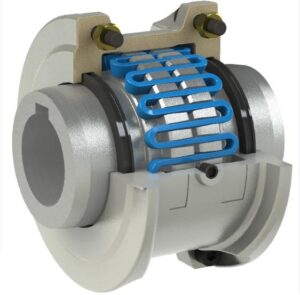
In mechanical engineering, torque is one of the most critical parameters used to evaluate the performance of couplings, gears, and rotating machinery. However, depending on the region or industry, torque may be expressed in different units, most commonly Newton-meters (N·m) in the metric system and inch-pounds (in-lb) or foot-pounds (ft-lb) in the imperial system. Converting between these units is essential for accurate equipment selection and technical communication.
Conversion Formula
The standard relationship between Newton-meters and inch-pounds is: 1 N\cdotpm=8.8507 in-lb1 \, \text{N·m} = 8.8507 \, \text{in-lb}1N\cdotpm=8.8507in-lb
This means that each Newton-meter of torque equals approximately 8.85 inch-pounds.
Practical Example: 9217 N·m
Suppose we have a torque rating of 9217 N·m for a coupling or other mechanical component. To convert this value into inch-pounds, we apply the formula: 9217 N\cdotpm×8.8507=81,577.32 in-lb9217 \, \text{N·m} \times 8.8507 = 81,577.32 \, \text{in-lb}9217N\cdotpm×8.8507=81,577.32in-lb
Therefore:
9217 N·m ≈ 81,577 in-lb
Engineering Application
- In design: When reviewing international specifications, engineers may need to quickly interpret torque ratings across different unit systems.
- In procurement: Many American suppliers list coupling ratings in in-lb or ft-lb, while international catalogs often use N·m.
- In safety: Proper conversion avoids underestimating or overestimating torque capacity, ensuring reliable operation.
Practical torque conversion
1 N·m ≈ 8.851 lb·in. Convert at the specification stage when mixing metric motors with imperial catalogs.
Apply a service factor for starts and reversals before selecting couplings or belt drives.
Need specifications or a quote? Contact NDS with your drawing, application, and quantity — our engineering team supports OEM and export orders worldwide.