Coupling elastomers are critical components in industrial power transmission systems. They absorb vibration, compensate for shaft misalignment, reduce shock loads, and protect expensive rotating equipment from excessive stress.
Although elastomer spiders are designed as replaceable wear components, many industrial facilities experience premature coupling elastomer failure long before the expected service life.
In most situations, the elastomer itself is not defective. Instead, improper installation, shaft misalignment, overload conditions, excessive heat, unsuitable materials, or poor maintenance practices are usually responsible.
Understanding these failure mechanisms allows maintenance engineers to reduce unexpected downtime, extend coupling life, and improve overall equipment reliability.
1. Shaft Misalignment
Shaft misalignment remains the most common cause of premature coupling elastomer failure.
Although flexible jaw couplings are designed to accommodate limited movement, excessive angular, parallel, or axial misalignment continuously compresses the elastomer, creating uneven stress concentration.
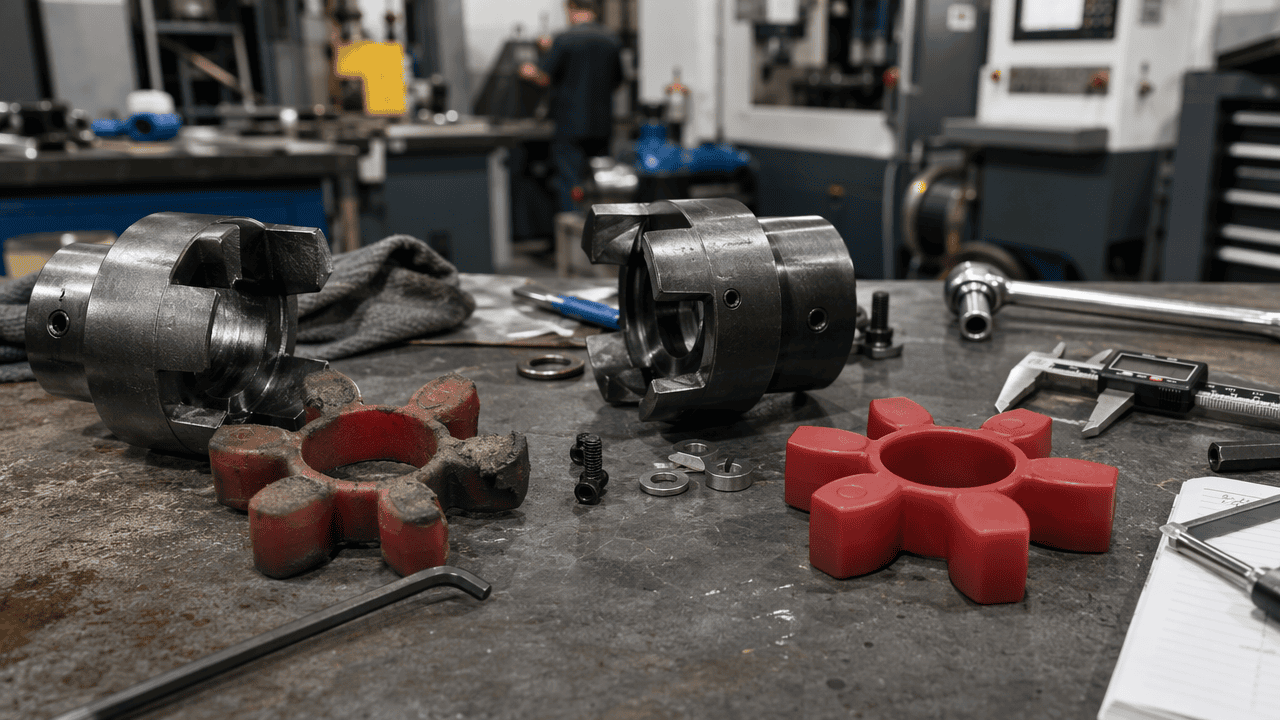
Over time, repeated loading causes fatigue cracks, permanent deformation, and accelerated wear.
Common Symptoms
- Fine cracks around the spider jaws
- Uneven elastomer wear
- Increased machine vibration
- Abnormal coupling noise
- Rising bearing temperature
Why It Happens
Even a small alignment error can dramatically increase cyclic stress on the elastomer insert.
Continuous operation under misalignment forces the spider to deform every revolution, significantly shortening its service life.
Inspection Procedure
- Check shaft alignment during installation
- Verify alignment after bearing replacement
- Use laser shaft alignment equipment whenever possible
- Inspect bearing wear regularly
Recommended Solution
Perform accurate shaft alignment before commissioning. Recheck alignment after major maintenance or machine relocation.
Replacing a worn elastomer without correcting alignment will usually result in repeated failures.
2. Excessive Torque
Selecting a coupling that cannot withstand actual operating torque is another major reason for elastomer failure.
Many applications experience short-duration peak torque much higher than the motor’s rated power.
Common overload situations include heavy startup loads, frequent reversing, sudden machine jams, shock loading, and large inertia equipment.
Common Symptoms
- Torn spider jaws
- Missing elastomer segments
- Permanent compression
- Severe deformation
Why It Happens
The elastomer is repeatedly compressed beyond its design limit. Instead of absorbing vibration, it begins to shear internally until complete failure occurs.
Inspection Procedure
- Compare operating torque with coupling rating
- Check for overload events
- Monitor motor startup current
- Inspect for repeated impact loads
Recommended Solution
Always select the coupling according to maximum operating torque rather than nominal motor power. A properly sized coupling significantly improves power transmission service life.
3. Incorrect Elastomer Material
Not all elastomer materials perform equally under different operating conditions.
Selecting the wrong material often results in premature aging, swelling, cracking, or hardening.
Common Symptoms
- Swollen elastomer
- Surface cracking
- Reduced flexibility
- Hardened material
- Rapid wear
Why It Happens
Each elastomer compound is designed for specific operating environments. A material suitable for general industrial use may fail quickly when exposed to high temperatures or petroleum-based oils.
Inspection Procedure
Verify the elastomer material against operating temperature, chemical exposure, required damping performance, torque level, and operating speed.
Recommended Solution
Choose the material based on actual operating conditions rather than price alone.
Elastomer Material Comparison
| Material | Oil Resistance | Temperature Resistance | Wear Resistance | Typical Applications |
|---|---|---|---|---|
| NBR | Excellent | Medium | Good | Pumps, compressors, hydraulic systems |
| Polyurethane (PU) | Good | Medium | Excellent | Heavy-duty industrial machinery |
| Hytrel | Good | High | Very Good | Servo systems, high-speed equipment |
| Natural Rubber | Poor | Medium | Moderate | General industrial machinery |
Selecting the correct elastomer material greatly improves coupling reliability and minimizes unplanned maintenance.
4. High Operating Temperature
Excessive heat is one of the most overlooked causes of coupling elastomer failure. Elevated temperatures accelerate material aging, reduce elasticity, and significantly shorten service life.
Common Symptoms
- Hardened elastomer
- Surface cracking
- Discoloration
- Reduced vibration damping
- Increased operating temperature
Why It Happens
Heat causes elastomer materials to lose flexibility over time. Continuous exposure to temperatures above the recommended operating range leads to permanent hardening and reduced shock absorption.
Common heat sources include poor ventilation, high ambient temperature, motor overheating, continuous overload, and high-speed operation.
Inspection Procedure
- Measure coupling surface temperature
- Check motor cooling performance
- Inspect ventilation around rotating equipment
- Compare operating temperature with the elastomer manufacturer’s specifications
Recommended Solution
Maintain operating temperatures within the recommended range. Improve ventilation, reduce overload conditions, and select high-temperature elastomer materials when necessary.
5. Chemical Exposure
Industrial chemicals can gradually degrade elastomer materials, reducing flexibility and mechanical strength.
Common Symptoms
- Swelling
- Sticky surface
- Softened material
- Surface cracks
- Discoloration
Why It Happens
Many elastomers are not compatible with petroleum products, hydraulic oil, solvents, acids, or aggressive cleaning chemicals. Long-term exposure changes the material’s physical properties and eventually causes failure.
Inspection Procedure
Check whether the coupling is exposed to hydraulic oil, lubricants, cleaning solvents, acidic chemicals, or coolants.
Recommended Solution
Select a chemically compatible elastomer material, such as NBR or other chemical-resistant compounds, based on the operating environment.
6. Poor Installation Practices
Improper installation can dramatically reduce coupling service life even when the correct coupling has been selected.
Common Symptoms
- Uneven wear
- Premature cracking
- Excessive vibration
- Loose hubs
- Spider deformation
Why It Happens
Common installation mistakes include hammering hubs onto shafts, incorrect shaft spacing, uneven bolt tightening, damaging the elastomer during assembly, and failure to verify alignment after installation.
Inspection Procedure
Verify shaft spacing, hub positioning, tightening torque, alignment, and spider installation.
Recommended Solution
Follow the manufacturer’s installation instructions and always perform a final alignment check before equipment startup.
7. Lack of Preventive Maintenance
Many coupling failures occur simply because routine inspections are skipped.
Since elastomer spiders are inexpensive wear components, replacing them early is far more economical than repairing damaged bearings, shafts, or gearboxes.
Common Symptoms
- Progressive cracking
- Missing elastomer sections
- Compression set
- Permanent deformation
- Abnormal vibration
Why It Happens
Without periodic inspection, minor wear gradually develops into complete failure.
Inspection Procedure
Routine inspections should include visual examination, shaft alignment check, spider wear assessment, bolt tightness verification, temperature measurement, and vibration monitoring.
Recommended Solution
Implement a preventive maintenance schedule based on operating hours and equipment criticality. Replacing a worn elastomer during scheduled maintenance minimizes unexpected downtime.
8. Early Signs of Coupling Elastomer Failure
Recognizing early warning signs allows maintenance teams to replace elastomer inserts before catastrophic failure occurs.
Common early indicators include:
- Increased machine vibration
- Abnormal knocking or rattling noise
- Black polyurethane or rubber dust around the coupling
- Fine surface cracks
- Permanent compression deformation
- Uneven wear on spider jaws
- Discoloration caused by overheating
- Loose or missing elastomer segments
- Higher operating temperature than normal
If any of these symptoms appear, inspect the coupling immediately to prevent damage to bearings, shafts, and connected equipment.
Maintenance Tip: Replacing an inexpensive elastomer insert early is significantly more cost-effective than repairing damaged rotating equipment after complete coupling failure.
9. Coupling Elastomer Inspection Checklist
Routine inspection is one of the most effective ways to maximize coupling reliability and reduce maintenance costs.
| Inspection Item | Recommended Frequency | Inspection Method | Purpose |
|---|---|---|---|
| Visual inspection | Monthly | Visual check | Detect cracks and wear |
| Shaft alignment | Every shutdown | Laser alignment | Prevent excessive stress |
| Spider wear | Every 6 months | Measure wear | Replace before failure |
| Coupling bolts | Quarterly | Torque check | Prevent loosening |
| Operating temperature | Weekly | Infrared thermometer | Detect overheating |
| Vibration level | Monthly | Vibration analyzer | Identify abnormal operation |
Consistent inspection records help identify recurring problems and improve long-term equipment reliability.
10. Common Failure Symptoms and Root Causes
Diagnosing coupling elastomer failure correctly is the first step toward preventing repeated downtime. Different failure patterns often indicate different underlying mechanical problems.
| Failure Symptom | Possible Cause | Inspection Method | Recommended Solution |
|---|---|---|---|
| Cracked elastomer | Shaft misalignment | Laser alignment | Realign shafts and replace spider |
| Torn spider jaws | Excessive torque | Review load conditions | Select a higher torque coupling |
| Swollen elastomer | Oil or chemical attack | Check surrounding environment | Replace with NBR or chemical-resistant material |
| Hardened elastomer | High operating temperature | Measure operating temperature | Improve cooling or choose high-temperature material |
| Missing elastomer segments | Shock loading | Inspect drive system | Reduce impact loads and increase coupling size |
| Uneven wear | Poor installation | Check shaft spacing and alignment | Reinstall according to manufacturer recommendations |
Proper failure diagnosis helps maintenance engineers solve the root cause instead of repeatedly replacing damaged elastomer inserts.
11. How to Choose the Right Coupling Elastomer
Selecting the correct elastomer is just as important as choosing the correct coupling size. The ideal material depends on multiple operating conditions rather than a single specification.
Before selecting an elastomer, evaluate the following:
- Maximum transmitted torque
- Continuous operating speed
- Shaft misalignment
- Ambient temperature
- Chemical exposure
- Required vibration damping
- Shock loading frequency
- Duty cycle
- Maintenance interval
Different operating environments require different elastomer materials. For example, polyurethane provides excellent wear resistance and high torque capacity. NBR offers outstanding oil resistance. Hytrel performs well in elevated temperatures. Natural rubber is suitable for general industrial applications requiring good vibration isolation.
Selecting the proper material significantly improves coupling reliability and reduces maintenance costs.
12. How to Extend Coupling Elastomer Life
Most premature failures can be avoided through proper selection, installation, and preventive maintenance.
To maximize service life:
- Select the correct coupling size based on maximum operating torque
- Choose an elastomer material suitable for the operating environment
- Perform accurate laser shaft alignment
- Avoid overload and shock loading whenever possible
- Keep operating temperatures within the manufacturer’s recommendations
- Prevent prolonged exposure to incompatible chemicals
- Inspect elastomer inserts regularly
- Replace worn spiders before complete failure occurs
- Maintain accurate maintenance records
- Train maintenance personnel on correct coupling installation procedures
Small improvements in maintenance practices can significantly reduce unexpected downtime and improve equipment reliability.
Engineering Best Practices
Experienced maintenance engineers rarely wait until an elastomer fails completely. Instead, they monitor vibration, temperature, alignment, and visual wear during scheduled inspections.
Predictive maintenance programs using vibration analysis and infrared temperature monitoring can detect coupling problems long before visible damage occurs.
Replacing a low-cost elastomer insert during planned maintenance is considerably less expensive than repairing damaged shafts, bearings, gearboxes, or electric motors caused by coupling failure.
For critical industrial equipment, coupling inspection should always be included in the preventive maintenance schedule.
Field Example: A packaging machine experienced severe elastomer edge wear every three months. Investigation revealed that the motor had been repositioned during maintenance without realignment, causing an angular offset that repeatedly damaged new spiders. After laser alignment was performed, the replacement elastomer lasted over two years with minimal wear.
13. Frequently Asked Questions
How long should a coupling elastomer last?
Under normal operating conditions, a coupling elastomer typically lasts between 2 and 5 years. Actual service life depends on transmitted torque, operating speed, shaft alignment, ambient temperature, chemical exposure, and maintenance practices.
What is the most common cause of coupling elastomer failure?
Shaft misalignment is the most common cause. Continuous angular, parallel, or axial misalignment creates uneven stress within the elastomer, eventually leading to fatigue cracks, deformation, and premature failure.
Can I replace only the elastomer spider?
Yes. Most jaw couplings are designed so the elastomer spider is a replaceable wear component. As long as the metal hubs are not damaged or excessively worn, only the spider needs to be replaced.
Can a damaged coupling elastomer damage bearings?
Yes. A worn elastomer can increase vibration and shaft misalignment, placing additional loads on bearings, shafts, seals, and connected equipment. Replacing a damaged spider promptly helps prevent more expensive mechanical failures.
Should jaw couplings be lubricated?
No. Standard jaw couplings with elastomer spiders are maintenance-free and operate without lubrication. Applying grease or oil is generally unnecessary unless specified by the manufacturer.
How often should a coupling elastomer be inspected?
Visual inspections should be carried out every month for critical equipment. During scheduled maintenance shutdowns, inspect the elastomer for cracks, wear, compression set, discoloration, and signs of overheating.
What causes excessive coupling vibration?
Common causes include shaft misalignment, worn elastomer insert, loose coupling hubs, bearing wear, excessive transmitted torque, and poor installation. The root cause should always be corrected before installing a new elastomer.
Which elastomer material offers the best wear resistance?
Polyurethane (PU) generally provides the highest wear resistance and excellent torque capacity, making it suitable for demanding industrial applications. However, the best material depends on the operating environment and application requirements.
Can high temperatures shorten elastomer life?
Yes. Continuous operation above the recommended temperature range accelerates material aging, reduces elasticity, and significantly shortens coupling service life.
Should the coupling be replaced when the spider fails?
Not necessarily. If the hubs remain within dimensional tolerance and show no excessive wear or cracking, replacing only the elastomer spider is usually sufficient.
Technical Note
This article is intended as a general engineering reference for industrial power transmission applications. Actual coupling selection should consider equipment specifications, operating torque, rotational speed, shaft alignment, environmental conditions, and maintenance requirements.
For critical applications, always follow the recommendations provided by the coupling manufacturer and applicable industrial standards.
Looking for reliable jaw couplings, elastomer spider inserts, or custom power transmission components? Our engineering team can help you select the right coupling solution based on your application, torque requirements, operating conditions, and maintenance objectives. Contact us today to discuss your project and receive professional technical support.
Conclusion
Premature coupling elastomer failure is rarely caused by manufacturing defects alone. In most cases, incorrect material selection, shaft misalignment, excessive torque, high operating temperatures, chemical exposure, improper installation, or insufficient preventive maintenance are the real causes.
By understanding these common failure mechanisms and implementing regular inspection routines, maintenance engineers can significantly improve coupling reliability, reduce unexpected downtime, and extend the service life of industrial power transmission equipment.
Investing in the correct coupling design and elastomer material from the beginning is often the most cost-effective way to improve long-term equipment performance.