Keywords: V-belt pulley, Imperial pulley, Metric pulley, taper bush, pulley bore, keyway standards, SPZ SPA SPB SPC
In power transmission systems, V-belt pulleys are widely used in industrial machinery, HVAC, conveyors, and agricultural equipment. However, pulley designations can be confusing because there are two main systems: Imperial (inch-based) and Metric (millimeter-based).
This article explains how to interpret pulley part numbers, convert between Imperial and Metric standards, and distinguish finished bore pulleys from taper bush pulleys.
1. Imperial vs. Metric Pulley Designations
Diameter Units
- Imperial: measured in inches (
") - Metric: measured in millimeters (
mm)
Groove Types
- Imperial: A, B, C, D, or 3V, 5V, 8V
- Metric: SPZ, SPA, SPB, SPC
Conversion Reference:
- A ≈ SPA/SPZ
- B ≈ SPB
- C ≈ SPC
- 3V ≈ SPZ
- 5V ≈ SPB
- 8V ≈ SPC
Bore and Keyway
- Imperial: shown in fractional inches
- Example: 1.1/2″ bore (≈ 38.1 mm), 3/8″ keyway (≈ 9.525 mm)
- Metric: shown in millimeters
- Example: 38 mm bore, 10 mm keyway
2. Groove Type and Size Conversion
| Imperial | Metric | Top Width (approx.) | Height (approx.) |
|---|---|---|---|
| A | SPA/SPZ | 13 mm / 10 mm | 8 mm |
| B | SPB | 17 mm | 11 mm |
| C | SPC | 22 mm | 14 mm |
| 3V | SPZ | 9.5 mm | 8 mm |
| 5V | SPB | 15.9 mm | 13.5 mm |
| 8V | SPC | 25.4 mm | 23 mm |
3. Diameter Conversion (Inch → Millimeter)
Formula: Inches × 25.4 = Millimeters
| Imperial | Metric |
|---|---|
| 5.5″ | 140 mm |
| 6″ | 152 mm |
| 8″ | 203 mm |
| 10″ | 254 mm |
4. Bore and Keyway Reference
| Bore (in) | Bore (mm) | Keyway (in) | Standard Keyway (mm) |
|---|---|---|---|
| 1″ | 25.4 mm | 1/4″ | 8 mm |
| 1.1/2″ | 38.1 mm | 3/8″ | 10 mm |
| 2″ | 50.8 mm | 1/2″ | 14 mm |
👉 Note: fractional keyways are rounded to the nearest ISO standard (e.g., 3/8″ = 9.525 mm → standardized as 10 mm).
📌 5. Example: Reading an Imperial Pulley
Imperial designation:
5.5″*2B1.1/2*3/8″**
Breakdown:
- Outside diameter = 5.5″ ≈ 140 mm
- Two grooves, B section
- Bore = 1.5″ ≈ 38 mm
- Keyway = 3/8″ ≈ 10 mm
Metric equivalent:
140-2SPB-38-10
6. Finished Bore vs. Taper Bush Type
Finished Bore Pulleys
- Include bore and keyway dimensions in the designation
- Examples:
5.5"*2B**1.1/2*3/8"(Imperial)140-2SPB-38-10(Metric)
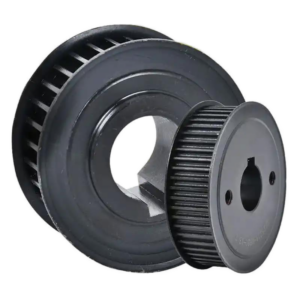
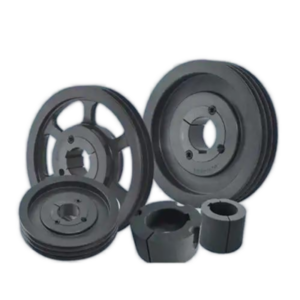
Taper Bush Pulleys
- Do not include bore/keyway in the pulley designation
- Instead, they specify a bush number (e.g., 1210, 1610, 2012)
- Example:
180-2SPB-2012
7. From Pulley Designation to Product Family
Once you have identified the profile code and mounting type for your drive, the next step is to locate the matching product family in the catalog. This section explains where each designation points in the current NDS public catalog and what to include in a quote request.
European Profile Route
The Metric profile codes SPZ, SPA, SPB, and SPC discussed in this guide are grouped under the European Standard Pulley category. The current public catalog lists families for SPZ and SPA profiles — visit the European Standard Pulley page to browse the available families (SPZ-01 through SPZ-04 and SPA-01 through SPA-05).
If your drive requires an SPB or SPC family, include the profile designation and your operating requirements in your inquiry so availability can be confirmed.
American Catalog Route
The current American Standard Pulley catalog lists the 8V narrow V-belt families — 8V/4, 8V/5, 8V/6, 8V/8, and 8V/10. Visit the category page to inspect drawings and request a quote for the matching family.
The classical profiles A, B, C, D and the additional narrow profiles 3V and 5V are designation codes used in pulley and belt identification. If your drive requires one of these profiles, include the designation and operating requirements in your inquiry so availability can be confirmed.
RFQ Preparation Checklist
When requesting a quote, including the following information (where known or relevant) helps the engineering team respond accurately and quickly:
- Belt or pulley profile designation, if known (e.g., SPA, SPB, SPC, SPZ, 8V)
- Number of grooves
- Pulley model or full designation, if known
- Pulley diameter or existing dimensions, if known
- Bore requirement (finished bore or bush type, if known)
- Mounting method (taper bush number, finished bore with keyway, etc.)
- Quantity per shipment
- Drawing, specification sheet, or photo of the existing pulley, if available
- Application or machine description (where relevant)
- Shaft speed / motor speed / driven speed (where relevant)
- Power information such as motor kW or HP (where relevant)
Use the free-text field of the inquiry form to capture anything that does not fit a fixed field. A short note such as “replacing existing SPA/02 pulley on a 7.5 kW motor at 1450 rpm” is often the single most useful line in a quote request.
8. Common Taper Bush Sizes
| Bush No. | Bore Range (mm) | Common Keyway (mm) |
|---|---|---|
| 1210 | 11 – 32 | 4 / 5 / 6 / 8 / 10 |
| 1610 | 14 – 42 | 5 / 6 / 8 / 10 / 12 |
| 2012 | 19 – 50 | 6 / 8 / 10 / 12 / 14 |
| 2517 | 25 – 65 | 8 / 10 / 12 / 14 / 16 |
| 3020 | 30 – 75 | 8 – 18 |
| 3525 | 35 – 90 | 10 – 22 |
| 4030 | 40 – 100 | 12 – 25 |
| 5040 | 50 – 125 | 14 – 32 |
Quick Identification:
- Fractional bore/keyway (e.g., 1.1/2, 3/8) → Imperial finished bore
- Metric bore/keyway (e.g., 38-10) → Metric finished bore
- Bush numbers (1210, 1610, 2012, etc.) → Taper bush type
Conclusion
- Finished bore pulleys: specify exact bore and keyway in either inches or millimeters.
- Taper bush pulleys: rely on bush numbers; bore and keyway are determined by the bush.
- Conversion rules:
- Inches × 25.4 → Millimeters
- Groove types: A/B/C ↔ SPZ/SPA/SPB/SPC
- Fractional keyways → nearest ISO standard sizes
By following these rules, engineers and buyers can confidently convert Imperial ↔ Metric ↔ Taper Bush pulley designations, ensuring accurate product selection and smooth equipment compatibility.
Need specifications or a quote? Contact NDS with your drawing, application, and quantity — our engineering team supports OEM and export orders worldwide.